
Where Did They All Go?
History of hitchhiking Part IV

In my life, I’ve seen three hitchhikers in Britain. Sadly I was unable to pick up any of them. The third I met earlier this year while hitchhiking myself in the Peterborough services. She told me not to get my hopes up. She’d been waiting there for three days.
The empty roadsides are a far cry from the days of my parents’ youth. In those days it wasn’t uncommon to see queues on the slip road. Indeed the 1985 edition of the Hitchhiker’s Manual even has an entire section on queuing etiquette.
But hitchhiking has been dying a steady death since those heady days. The Lonely Planet officially disowned it in the 90s: ‘These are not the Kerouac days of old. The culture of hitchhiking has changed dramatically and we feel it is so dangerous we would rather people didn’t take the risk.’
By the 2000s, hardly anyone hitchhiked. In the words of Joe Moran in a 2009 Guardian article, the hitchhiker is almost as endangered as the snow leopard.
So what happened? Where did all the hitchhikers go?
The Pessimistic Argument
There are, as you’d expect, several schools of thought. They can be broadly split between pessimism and optimism.
We’ll begin with the pessimistic and when feeling pessimistic, it’s never a bad idea to blame Thatcher.
‘Who is society? There is no such thing,’ she famously said. ‘There are individual men and women and there are families.’ The years of her premiership, as individualism and neoliberalism took hold across the West, saw the ‘no such thing as society’ philosophy percolate, with all its many repercussions.
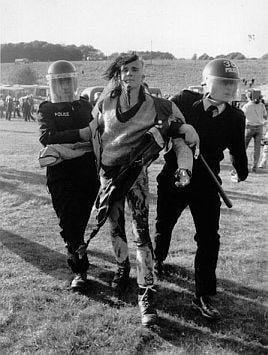
The infamous Battle of the Beanfields is often held up as evidence of the shift. The police’s battering of unarmed New Age Travellers at Stone Henge in 1985 became a symbol of the new intolerance of hippies, freeloaders and people who were unwilling to conform. Hitchhiking was never directly targeted as such, but it didn’t fit the mould.
However there were also other things going on in the 80s and 90s too, and blaming Thatcher alone for hitchhiking’s demise would be a little rash.
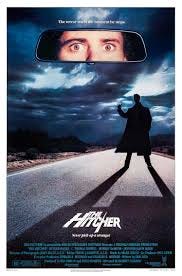
There was a string of high-profile murders, covered by the newly aggressive tabloids. The Hitcher, the 1986 psychological thriller about a serial killer, did little to help the image and neither did The Texas Chainsaw Massacre. Hitchhiking’s association with horror films, creeps and murderers solidified, even if there was little or no grounding for this in fact.
Today, there seems to be a nebulous sense among people I meet that you can’t trust strangers anymore, that the world is too dangerous. People often tell me they hitched back in the day, but they wouldn’t want their grandkids doing it. An old boy in Kent told me that there are simply ‘more nutters’ about today. People could be on drugs.
But I don’t buy any of that, nor Thatcher’s famous quip. There is of course a fear of strangers, but for as long as people have existed, there has always been a fear of strangers. I don’t believe it is any more intense now than in the past - three years hitchhiking here have taught me that - it just manifests in different ways.
The Age Old Fears
‘Then there is the fragile old lady from beneath whose petticoat peeped the cuffs of a man’s trousers or from whose knitting bag protruded the muzzle of a machine gun… She flits in the dusk on the outskirts of Chicago and appears in the dawn southwest of Denver. She proves that “you never can tell.” … “Don’t pick ‘em up! Don’t pick any of ‘em up!’
That was written in 1939 and is one of countless such examples from the history of hitchhiking.
The truth is, hitchhiking has always battled a bad reputation and the reason is quite simple, and far older than hitchhiking.
At its heart, hitchhiking involves a relationship between strangers, and humans have always had a complex relationship with strangers. There is a tension between the joys of meeting, connecting and learning about someone new, and a fear of the unknown, of who they might be or what they might do to us.
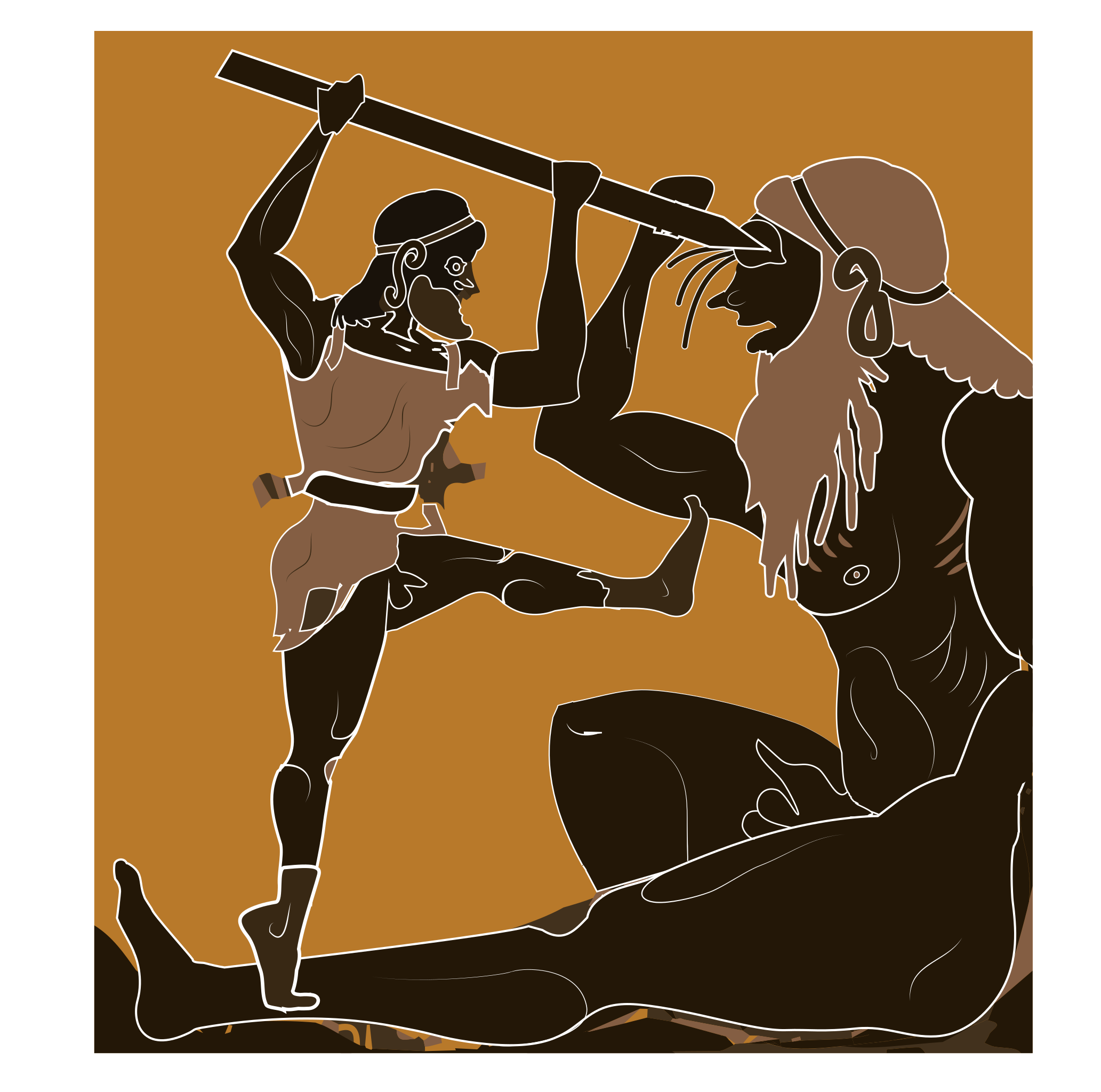
Such tensions can be seen in hospitality rituals, art and stories from across the world, like the Epic of Gilgamesh or the Odyssey. Odysseus is hosted by many strangers on his journey, sometimes for better, sometimes for worse but the fear that it could go either way runs through all the encounters.
Hitchhikers also evoke another deep-seated societal fear: vagrancy. In our settled world, the footloose and the drifters are often regarded with suspicion. Take any of the Vagrancy Acts that have been passed in the last 500 years.
1572’s for instance was particularly brutal. It said that any able-bodied vagrants would have their ears burned through with a hot iron. If caught twice they would be executed. As with many similar acts, it was passed at a time of great societal change. Urbanisation and poverty were on the rise, so too was a fear of strangers.
Indeed, how we perceive strangers waxes and wanes. During wars, as we’ve seen in earlier chapters, that fear all but disappears. It may have waned recently but I’ll bet it’ll change again one day.
But that still doesn’t quite explain where all the hitchhikers have gone.
The Optimistic Argument
For all the arguments about the deterioration of trust and the rise of individualism, there are as many straightforward, rather less glamorous explanations.
Take transport. Nowadays, more young people have cars. Student car parks are full where once only a handful drove. Public transport is relatively cheap too. Railcards make trains cheaper and it’s possible to get a bus almost anywhere in the country for a few quid. I once went from London to Manchester for less than the tube fare to the bus station.
Then there’s the fact that young people simply get their kicks in other ways. The sociologist Mario Rinvolucri wrote about how hitchhiking ‘severed the umbilical cord’ for young adults. Of course, young adults still sever their umbilical cords but they do it elsewhere and in different ways, like Magaluf or Thailand. Flights are cheap, it’s warm and generally more exciting than being splashed by lorries or given the middle finger on the outskirts of Birmingham.
Then there’s technology.
This is somewhat counterintuitive because, thanks to technology (mainly the smartphone) hitchhiking is safer than it ever was. My parents usually track me as I go, I could send them a picture of the driver and number plate before getting in and could call the police from the car if I needed. None of those security measures existed when hitchhiking was popular.
But precisely because we have smartphones, how we trust people has changed. I don’t believe that we necessarily trust people any less, we just trust in different ways.
We get in strangers’ cars all the time, we just arrange it on Uber, or perhaps Bla Bla Car (a popular ride-sharing app in Europe). We are happy to stay in strangers’ homes too, so long as we book it through apps like Airbnb or Couchsurfing.
Technology has also removed one of the key motives for people picking up hitchhikers: company. Joe Moran observed in 2009: ‘Now cars have ergonomic driving seats, remote-controlled iPods and automatic temperature controls. Why would we invite a sweaty stranger into this snug haven?…In the soothing micro-environment of a modern car, there really is no such thing as society.’
Perhaps more significantly, all this technology has changed our relationship with time and travel itself. Google Maps and the blue dot have altered our perception dramatically. We know our exact location, the exact minute of arrival, the exact route, even the traffic we’ll hit on the way. Uncertainty has been completely erased. We want our journeys between places to be minimised. If we could, we would make them disappear altogether.
In that context, it’s little wonder hitchhiking is unpopular. It is, at its core, uncertain. It requires a plunge into the unknown. You don’t know how long you’ll wait, who will pick you up, where you’ll be dropped, what time you’ll get there, if you get there at all, or if you’ll spend three days in Peterborough services.
Ultimately, hitchhiking is heavily at odds with our society. It’s difficult, slow and uncertain, things which most people nowadays aren’t into.
You don’t need me to tell you the world has changed a great deal since the final edition of The Hitchhiker’s Manual was published. Cracks have appeared as great plates have shifted, risen and fallen and hitchhiking, for better or worse, has slipped through several of them. Whether this is temporary, who knows.
But as we’ll see next time, I believe the case for it now is stronger than ever.
I hitchhiked a lot, in the 70s, in England, in France, in Germany, and eventually in Israel.
We took turns to wear shorts, because it was hot. Whoever went in front wore trousers, we took turns.
I cannot tell you the number of times we had to deal with wankers, literally, and that was such a nightmare. Leaping out of cars wherever whenever necessary.
I would never hitchhike today as a woman, a lot older, obviously. But it's always a risk for women but it was fantastic when it worked and we got to places where we wanted to go.
I admire you for sticking to this wonderful way of travelling. And long may it last .
This captures it. Hitchhiking was the slowest, least efficient, and most unpredictable form of travel I ever took … and far and away the most interesting.